
Simulation and Training in an Uncrewed Future
aka Drones – UAV – sUAS – RPAS – UMS – USV – UUV – UGV – OPV … Remotely Operated – Autonomous
This analysis by Andy Fawkes was presented at the Joint Military Training & Simulation Conference, Bristol, February 2026. All data drawn from open sources and conversations.
Starting with a number: 80%. In Ukraine today, 80% of targets are engaged by uncrewed systems. The British Army has set a similar target for the future force with 80% of effects delivered from uncrewed platforms, split between recoverable and one-way systems, with crewed platforms providing just 20%. The UK’s SDR 2025 describes “dynamic networks of crewed, uncrewed, and autonomous assets” spanning all three services. The Royal Navy wants autonomous vessels patrolling the North Atlantic. The Army is planning land drone swarms. The RAF’s Future Combat Air System pairs a sixth-generation crewed jet with autonomous collaborative platforms. In the US, the ‘Unleashing US Military Drone Dominance‘ directive was published in July 2025 stating that ‘Drones are the biggest battlefield innovation in a generation’ and that in 2026 it expects ‘to see this capability integrated into all relevant combat training, including force-on-force drone wars’. This is not a long-range forecast, it is current policy. Furthermore, beyond Ukraine, low cost drones are being used by both sides in the current Iran war. So the practical question for the training and simulation community isn’t whether to respond — it’s how, and how quickly.
Tempo, Scale and Economics
At the parallel Strike Drone Study session I learnt that Ukraine spent approximately $30 million on drones in a single month (Jan 26) and estimates it destroyed $3 billion worth of Russian equipment: a 100-to-1 return. Russia has trained 80,000 drone operators and plans to double that number in 2026. Ukraine produced over four million drones in 2025. The UN reports that 118 countries now possess some drone capability.
Against that backdrop, the training demand presented at major training and simulation conferences is surprisingly weak. A 110-page I/ITSEC 2025 program mentioned “drones” six times and “uncrewed” not at all.
The technology is also evolving faster than most acquisition systems are designed to handle. The UK Prime Minister’s office has stated that average drone development cycles at around six weeks, a cadence that makes conventional 12-month training development timelines look slow. Air Marshal (Retd) Edward Stringer has made the point directly: “The future of warfare does not look exactly like Ukraine, but it certainly involves a lot of what you are seeing in Ukraine, adapted for future theatres.”
In future, the New Zealand MoD anticipates that military capability will shift to ‘software supporting hardware, to hardware supporting software’. As success is increasingly defined not by platforms and capabilities, but by the software that operates and connects them, this will inevitably speed up development cycles.
The Training Data We Have
Drawing on conversations with drone training experts and a growing body of open-source evidence, a picture is emerging. Training to basic drone competence takes roughly 25–40 hours. Combat readiness in the Ukrainian model takes around three to four weeks, with approximately 9:1 simulation to live flying by flight hour. Laptops are made available 24/7 and instructors report trainees practising through the night. Software updates are distributed in days via messaging apps to tens of thousands of users. The system is fast because it has to be.
The US Army is running a 10-hour introductory sUAS course using VBS4 and a Virtual Drone Collective Trainer plug-in, taking infantry and armour trainees from basic controls through to simulated strikes. Top performers are fast-tracked. The UK’s Task Force Rapstone is fielding 3,000 quadcopters in three size variants, with a minimum 15 hours of simulator training required before any live flying.
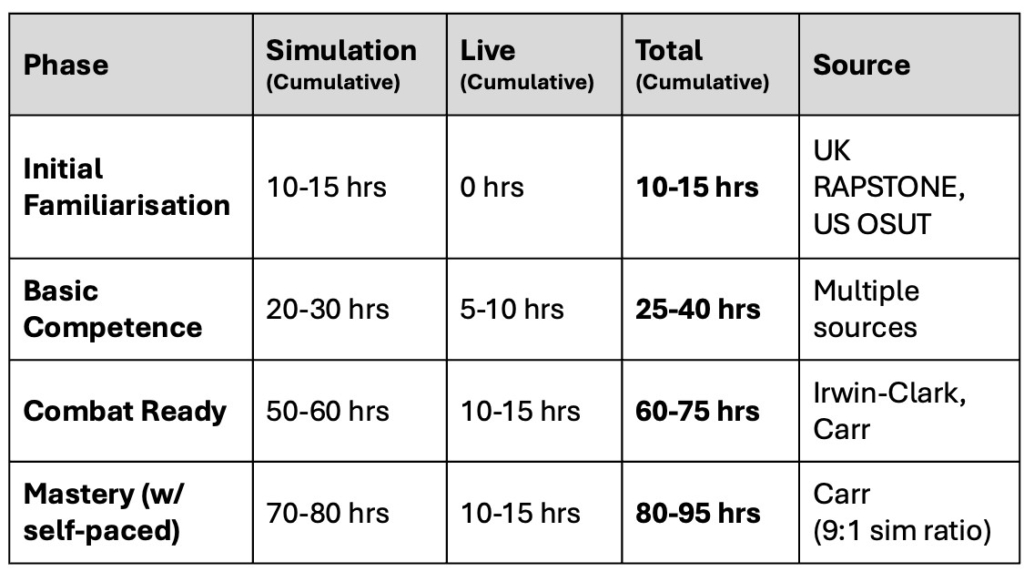
Drone Pilot Training and Simulation Data Consolidation – Multiple Sources
At unit level, 1st Battalion Irish Guards has taken a notably practical approach. The Commanding Officer described watching young soldiers gaming in their barracks at night and recognising rather than dismissing those skills. Around 25% of the battalion’s 276 personnel are now drone-qualified, working toward a 60-hour online flying target.
The data on who trains best is consistent across multiple sources: operators under 28 have a failure rate of around 3%, compared with 15–20% overall. Gaming backgrounds correlate strongly with performance, with spatial reasoning, rapid decision-making under cognitive load, and comfort with operating through abstractions as skills that transfer well. The RAF now explicitly lists gaming and computing as relevant interests for pilot selection.
How Many Pilots?
Two numbers sit uncomfortably next to each other. In June 2025, the Chief of the General Staff said the Army had trained over 3,000 drone pilots and planned 6,000 more, with 200 simulators going into unit lines. In February 2026, the Armed Forces Minister confirmed that 282 personnel are currently participating in centralised sUAS training pathways, and that distributed training figures are not held centrally.
It reflects a structural challenge: unit-driven training is fast and responsive, but without data capture and enterprise visibility, it’s hard to know what the force actually knows. The regulatory picture adds further friction. Drone types approved for live training one month may be superseded the next. Military Aviation Authority approvals, designed for stable platforms, don’t map neatly onto a technology that evolves in weeks.
Five Roles for Simulation in an Uncrewed Future
Based on current evidence and the training models emerging from operational experience, simulation has at least five distinct roles to play, and several of them represent significant expansions of how the community currently operates.
1. Mass training at speed. The Ukrainian model demonstrates that simulation-first, simulation-heavy training works. Scaling that model for NATO-sized forces requires simulation infrastructure, software, hardware, and instructor capacity, to be treated as a strategic asset, not just a budget line.
2. Rapid scenario development. When tactics change in weeks, scenario libraries need to keep pace. The simulation community could be building development pipelines, drawing on operational data and front-line feedback, that can update training content on similar timescales to the threats themselves.
3. Live training must embed drone elements into existing force-on-force training and are all achievable with current technology. However, approvals to operate must speed up and adapt to rapid change in drone designs and operations. Training drones must also integrate with w wider training systems.
4. Data capture and enterprise learning. The disconnect between unit-level training activity and central visibility is solvable. A simulation-centred enterprise approach could track training completion, performance data, and qualification status across the force, providing the kind of real-time picture that operational commanders and ministers currently lack.
5. Testing AI and human-machine teaming. Evidence from Ukraine suggests AI targeting assistance roughly quadruples hit probability for unskilled pilots, but provides only modest improvement for experienced operators. Working out how operators and AI systems should interact including for swarms, and training people accordingly, is a simulation task before it’s a live one.
Three Options for the Enterprise
To keep pace with an uncrewed future, the training enterprise faces a structural choice between three broad approaches.
- The first is incremental adaptation, compressing the existing systems approach to training (JSP 822) from years to months through parallel development and streamlined approvals. This is achievable but may not be fast enough when requirements are changing weekly rather than annually.
- The second is a dual-track model: maintaining rigorous processes for stable, long-cycle platforms like fast jets and submarines, while running a separate rapid-iteration track for software-defined capabilities, drones, cyber, electronic warfare. This approach is pragmatic and immediately achievable, though it requires clear governance for where each capability sits and how the tracks interact.
- The third is enterprise transformation, training as a data-driven, continuously adapting system across the whole force, with simulation at the centre rather than the periphery. This is the highest ambition and the most future-proof, but it requires investment decisions now rather than after the next strategic review.
None of these options is without cost or difficulty. The question is which cost is more acceptable: the overhead of building a more capable system, or the operational risk of continuing with one that can’t keep pace.
What Happens Next
Optionally piloted vehicles are already operational. A US Army soldier was trained to operate an autonomous UH-60 Black Hawk in under an hour in August 2025. China has demonstrated swarm control of over 22,000 drones simultaneously. The pace of change is dramatic, driven by war and by technologies often originating beyond defence.
The demand signal is clear and the tools exist. Building rapid scenario development pipelines, capturing distributed training data at enterprise level, and beginning serious work on human-machine teaming and swarm operator training. We must keep pace with battlefield developments measured in days and weeks, not years.