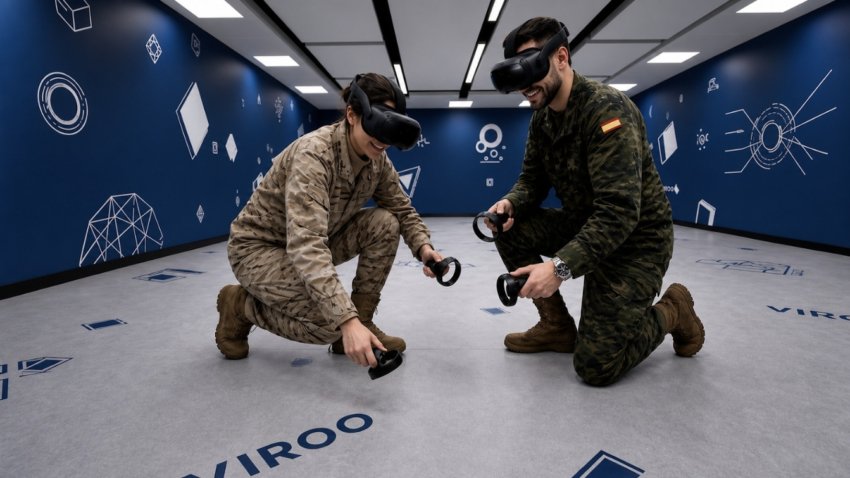
Immersive Infrastructure Consolidates as a Key Element in Military Training: VIROO and Virtualware at Eurosatory
An Article by Virtualware ·
Extended reality (XR), encompassing immersive technologies, is no longer a technological promise but has become a real tool within military training. However, the key shift lies not only in the quality of virtual environments, but in the ability to deploy, manage, and scale them as part of a critical infrastructure. In the defence field—where security, interoperability, and long lifecycle requirements are essential—the approach has evolved: it is no longer about isolated experiences, but about integrated platforms capable of supporting training over the long term.
Beyond Simulation: A Shift in the Model
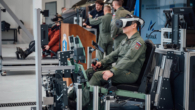
Various studies and pilot programmes in the defence sector confirm the value of extended reality (XR) as a training tool. A report based on surveys of US military personnel indicates that 81% believe XR improves confidence and muscle memory, while nearly 80% state that it increases training effectiveness. Additionally, 76% highlight that these technologies enable training to be completed in less time.
Other applied research in real military environments shows that virtual reality training can achieve performance levels comparable to live-fire training in decision-making tasks, reinforcing its validity as an operational complement.
Studies such as the German Army’s VIRTUOS project also indicate that XR enhances operational readiness by enabling the recreation of complex scenarios, training cognitive responses under pressure, and conducting detailed post-exercise analysis.
These insights confirm that XR not only improves efficiency but also enhances the quality of training and personnel readiness in high-demand environments.
Immersive technologies already provide recognised advantages in the military domain:
- Continuous repetition of complex manoeuvres
- Simulation of scenarios that are difficult to recreate in real life
- Collaborative training across different units
But their real impact goes further. They accelerate learning, reduce the cost associated with real equipment, and enable rapid adaptation of training to changing scenarios. The challenge arises when these capabilities must be scaled in real environments: restricted networks, data sovereignty requirements, classified scenarios, or even fully isolated systems. In this context, technological infrastructure becomes the differentiating factor.
VIROO: Immersive Infrastructure for Defence
In this scenario, VIROO is positioned as Virtualware’s XR platform designed to deploy and manage immersive environments in a structured way. This enterprise platform enables:
- Real-time multi-user sessions
- Centralised content and user management
- Operation in connected or isolated environments (including air‑gapped scenarios)
- Integration with existing corporate systems
This approach transforms virtual reality into an operational capability, aligned with the security, governance, and continuity requirements of the defence sector. Rather than isolated projects or pilots, VIROO introduces an infrastructure logic: lifecycle control, consistency across deployments, and long-term scalability.
SIMUR: Immersive Training in Critical Environments
A concrete example is SIMUR, a simulator developed together with the Military Medical School (EMISAN).
This system reproduces medical protocols under NATO standards in complex environments, including CBRN (chemical, biological, radiological, and nuclear) scenarios. SIMUR enables:
- Training medical procedures under high-pressure conditions
- Improving real-time decision-making
- Enhancing readiness in multi-domain environments
The simulator has been presented as a real and operational use case in NATO working groups and at major national and international events, including I/ITSEC, FEINDEF, the European Defence Innovation Days, the BACSI exercise, and the REAIM forum, showcasing its practical application in advanced training environments and alignment with real operational needs.
Virtualware at Eurosatory
Building on this track record, Virtualware will participate in Eurosatory 2026, one of the leading international defence and security events, taking place in Paris from June 15–19.
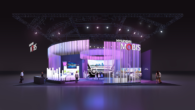
Virtualware will exhibit within the Spain Pavilion, showcasing how VIROO enables the deployment of secure and scalable immersive infrastructures.
With more than 20 years of experience, the company has strengthened its position in the defence sector through:
- Collaborations with the Ministry of Defence
- Participation in NATO-related projects
- Presence at international forums and operational exercises
References
Its proposal stands out due to its focus on data sovereignty and its ability to deploy solutions across cloud, on‑premise, and fully isolated environments.
The development of immersive infrastructures represents a structural shift in military training. It is no longer just about simulation, but about integrating training into the organisation’s digital ecosystem.
In an increasingly complex geopolitical context, the ability to train flexibly, securely, and at scale has become an operational advantage.
Solutions such as VIROO and use cases like SIMUR demonstrate that immersive training has moved beyond the experimental phase and is becoming a key tool for improving readiness and decision-making.
In defence, technology is not measured by what it promises, but by what it can sustain under real conditions. In this scenario, immersive infrastructure is no longer a complement—it is part of the capability.
- HTC VIVE, The State of Extended Reality (XR) Training in the U.S. Military, 2023.
- Harris, D. J. et al., Exploring the role of virtual reality in military decision training, Frontiers in Virtual Reality, 2023.
- HGXR, The Impact of Extended Reality (XR) Training for Military, Police, and Enterprise (VIRTUOS Study), 2024.
- NATO Science and Technology Organization, Framework for the Assessment of XR Technologies in Training and Education, 2024.
About Virtualware
Virtualware is an enterprise XR (Extended Reality) software company founded in Bilbao, Spain, in 2004. They specialize in 3D-driven solutions and develop VIROO, an award-winning enterprise VR platform that allows organizations to create, manage, and deploy shared, multi-user virtual reality applications across industries.