From Shotguns To Simulators: Ukraine’s Hard-Won Training Lessons
Martin Carr of AVS, Mikko Luhtava of Varjo and Kristine Kvam of Fynd Reality, one high-end headset maker and two training-system builders using it, recently joined a roundtable on how Ukraine’s armed forces are training.
Warfighters Making Choices
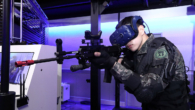
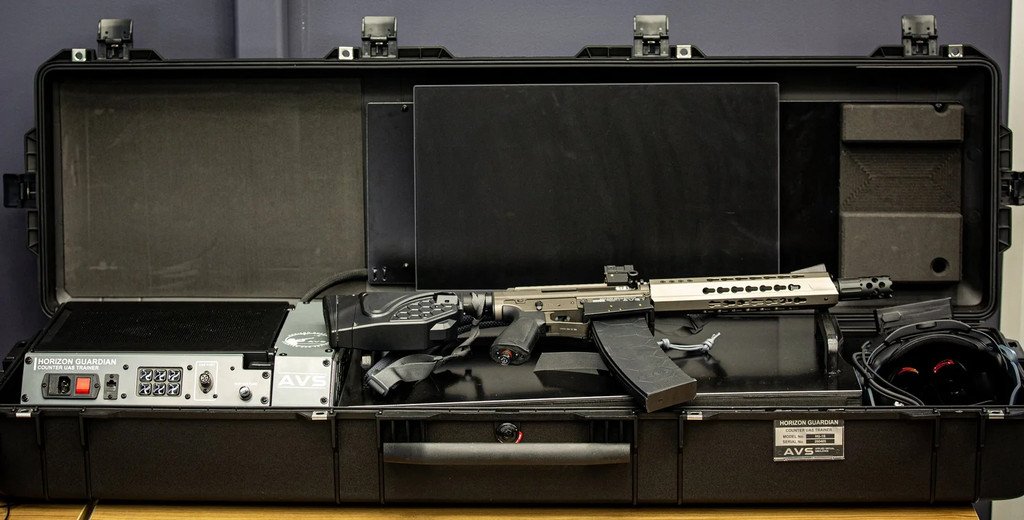
A soldier who spends his own wages hauling a heavier weapon into combat is not wasting his time, said Martin Carr, UK director at Australian training-systems firm AVS. That was his conclusion after talking to troops near Pokrovsk last summer who had bought shotguns privately for use against first-person-view drones. AVS built a counter-UAS trainer, Horizon Guardian, around the finding, and picked Varjo’s headset specifically because tracking a small target moving fast against open sky demands near-human visual acuity. Any blurring can significantly degrade the training.
Fixed Ranges Are Targets
Mikko Luhtava, chief marketing officer at Varjo, framed the shift bluntly. Practically every operational vehicle in Ukraine is at the front, so soldiers rarely touch a platform before they deploy on it, and fixed training ranges have themselves been struck. Concentrating people and equipment in one place is now a liability, not an efficiency. Training has to move to the point of need, stay distributed, and carry a small footprint, as curricula built around static courseware go stale as fast as the counter-drone tactics they’re meant to teach.
A Decade Of Expansion
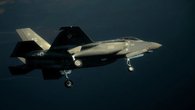
Varjo, a Finnish company founded in 2016 by veterans of Nokia, Microsoft and Nvidia, now supplies headsets into more than 120 defence training programmes across NATO and allied nations, including the Royal Air Force, the Finnish Air Force and Army, and the US Air Force, Navy and Army. In Ukraine specifically, its hardware sits inside three areas: Fynd Reality’s Leopard 2 tank-training platform, covering 39 systems in its first rollout; AVS’s Horizon Guardian counter-drone trainer; and Czech firm Dogfight Boss’s F-16 mixed-reality cockpits used to train pilots in-country.
From Quest 3 To Varjo
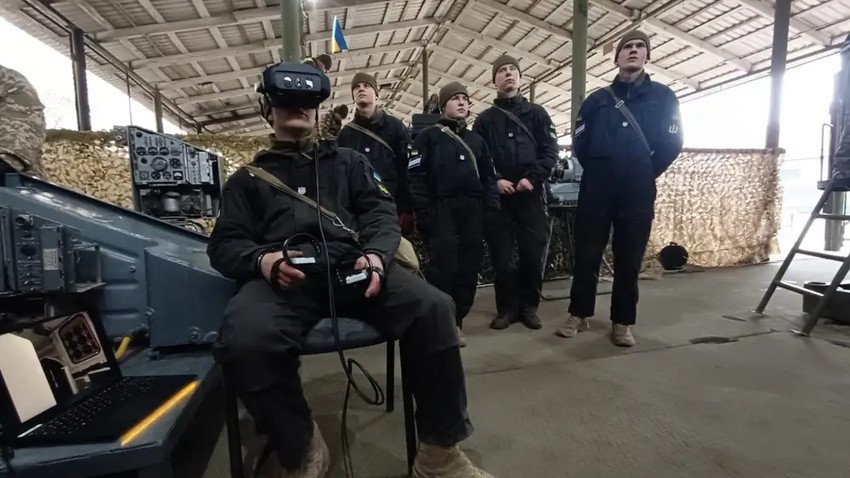
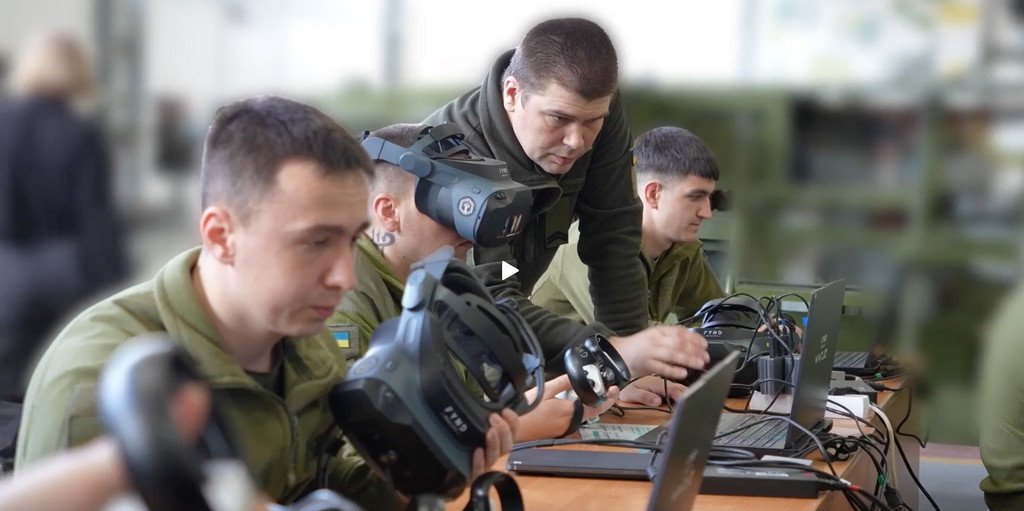
Fynd Reality, a Norwegian software company, built its first Ukraine deployment in 2023 to train crews on the Leopard 2A4 tanks Norway donated, initially on Meta’s Quest 3 before switching to Varjo hardware to meet safety requirements. Working with Kharkiv Polytechnic University’s tank institute, Fynd’s CTO Kristine Kvam described students running short Moodle-linked “micro-module” sessions in VR, then driving a real tank after a single day of training with no prior exposure. “It did not go perfectly,” Kvam said, “but they were able to use the equipment the way that it was supposed to do.” Ukrainian instructors also update training content themselves, building 3D models of field fixes without waiting on a Norwegian software release cycle.
AI Makes an Entrance
Artificial intelligence is finding some value in Ukraine’s training pipeline. Luhtava described customers using session data to give trainees real-time or after-action feedback, catching things that used to depend on an instructor watching over a shoulder. For Kvam, the bigger win is empowerment, as Fynd’s Ukrainian partners no longer need Blender or Unity skills to build content, so soldiers and instructors can turn their own frontline experience straight into training scenarios without waiting on a developer. Carr noted that large language models need an existing corpus to draw on, and this new form of counter-drone warfare doesn’t yet have one. For now, it’s the soldiers at the front generating that expertise, not a model trained on it.
The Case for Virtual Simulation
According to Kvam, Ukrainian trainees now spend roughly 80 percent of their time in the headset and 20 percent on real equipment simply because there isn’t enough equipment to go around. Norwegian instructors, working with the same platform, still default to walking down to the maintenance bay, a habit Kvam called a mental shift as much as a technological one. Carr’s list of what simulation can do that live training cannot is instructive. A 12-gauge recoil impulse is nearly impossible to replicate in a training weapon, but a barracks-based system runs every day, at night, and against attack profiles too dangerous to rehearse with live rounds. It also scales to entire militaries. Carr cited Australia’s own force of roughly 35,000, truck drivers and medics included, who will never be specialists but still need some exposure to the threat.
Scaling Up For War
Carr draws a line between that kind of scale and a harder one. NATO exercises struggle to concentrate the density of drone teams Ukraine fields daily, and electronic-warfare training is constrained by civilian spectrum rules that don’t apply on a real battlefield. The British Army’s chief told RUSI in June that every soldier needs to be able to use a drone but Carr argues the more urgent gap is command, as plenty of pilots are now qualified, but few officers know how to exploit a drone team once it’s under them. Unmanned ground vehicles were also seen as a new area of demand, and Carr confirmed Russia has fielded far fewer armed ground platforms in comparison to Ukraine, a gap he expects won’t last.
In 5 Years’ Time
Asked where training stands in five years, Luhtava and Kvam both expect a shift toward continuous, personalised, data-driven curricula rather than fixed courses. Barring a direct NATO commitment to the fight, Carr, however, anticipated “business as usual” and a steady technology adoption rather than the fundamental training overhaul that Ukraine has been forced into.
Featured Image – Ukraine Military Institute of Armored Forces, Tank Institute